- Determine the weight and dimensions of the boat
- Construction materials and their advantages
- Trailer design type
- Trailer running gear
- Additional features and equipment
- Practical tips before buying a boat trailer
- SP Premier trailers
Choosing the right trailer for transporting a boat or jet ski is an important task that requires careful consideration. An incorrectly selected trailer can lead to difficulties during transport, damage to the watercraft, or even accidents on the road. In this article, we will take a detailed look at the key aspects of choosing a trailer to help you make the right choice.
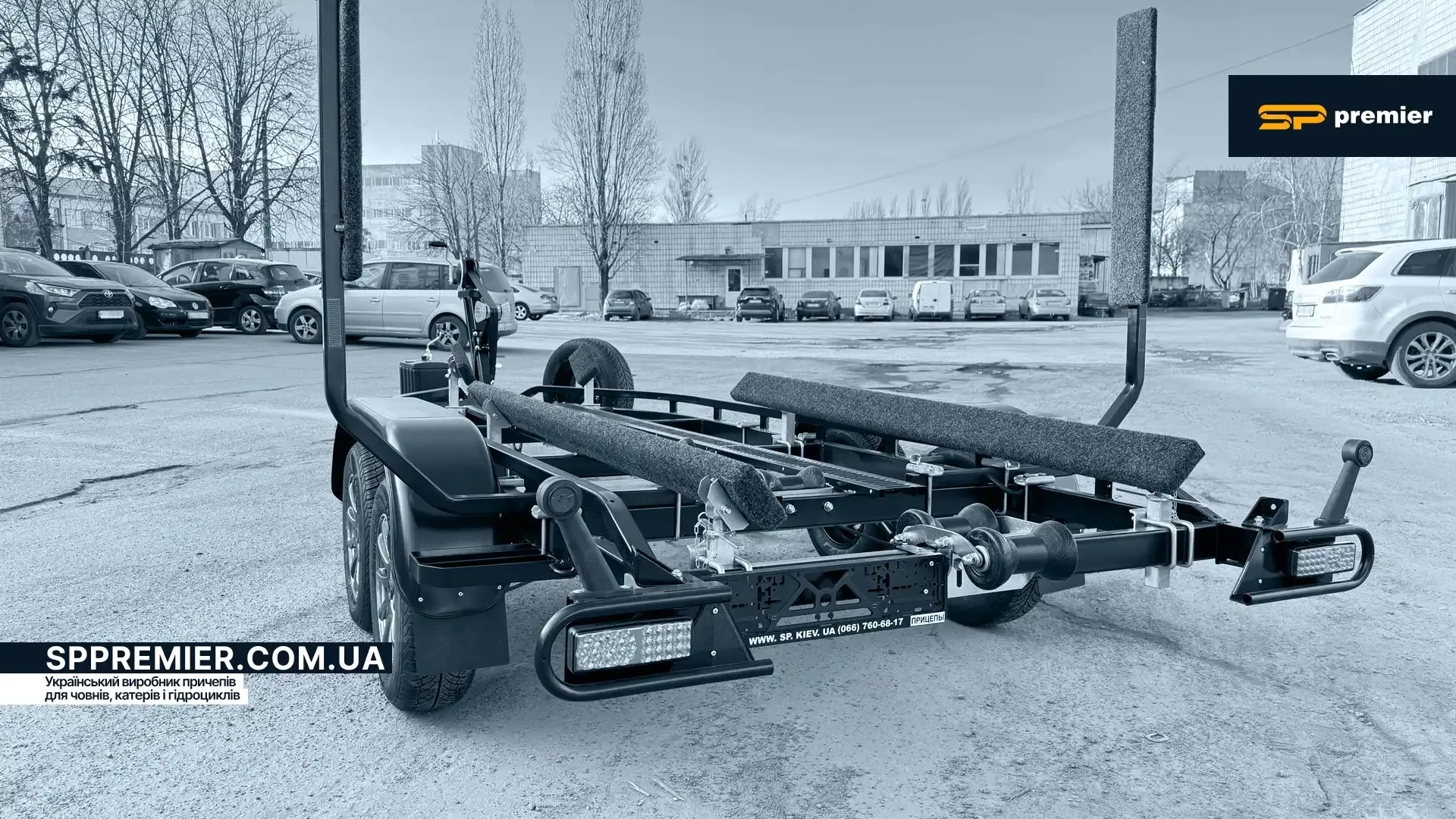
Determine the weight and dimensions of the watercraft
The first and most important step in choosing a trailer is to accurately determine the characteristics of your boat or personal watercraft. The main parameters to consider are:
Weight
Calculating the required load capacity of the trailer is a critical step in the selection process. An error in these calculations can lead to serious consequences, including trailer breakdown, damage to the vessel, or even a traffic accident.
The basic parameter for calculation is the total weight of the watercraft in equipped condition. This includes not only the weight of the hull itself, but also the engine, fuel, equipment, personal belongings, and everything else that is usually on board during transportation. It is important to note that the weight of the vessel can vary significantly depending on the fuel level in the tanks and the presence of additional equipment.
Choose a boat trailer with a load capacity reserve of at least 15-20% of the total weight. This will ensure safe transportation and durability of the trailer. For example, if the total weight of your boat with all equipment is 1500 kg, it is better to choose a trailer designed for 1800-2000 kg.
Dimensions
The correct selection of trailer dimensions ensures reliable fixation of the vessel and even load distribution. The length of the trailer should match the length of the boat with a small margin for ease of loading. A trailer that is too short will not provide adequate support, while one that is too long may be inconvenient to use and take up unnecessary space in the parking lot.
The width of the trailer must correspond to the maximum width of the boat at its widest point. Particular attention should be paid to the height and shape of the boat's sides, as these parameters affect the design of the trailer's support elements.
For jet skis, an important parameter is the distance between the support points, which must correspond to the design features of the bottom. Incorrect positioning of the support elements can lead to deformation of the hull during transport.
To find out these parameters accurately, refer to the documentation for your watercraft. If you do not know the weight, weigh it with the equipment on special scales.
Construction materials and their advantages
The materials used to manufacture the trailer affect its durability and corrosion resistance, which is especially important if you frequently launch the trailer into the water.
Steel trailers
Steel trailers are traditionally the most common due to their optimal price-to-strength ratio. They can withstand heavy loads and are highly repairable. However, these trailers are heavier, and steel is prone to corrosion, especially when in constant contact with water and moisture.
If you plan to purchase a steel trailer, choose one made of hot-dip galvanized steel, which protects against corrosion and makes the trailer suitable for use in fresh and salt water. For additional rust protection, trailers can be painted with powder coatings.
Aluminum trailers
Aluminum trailers are becoming increasingly popular due to their corrosion resistance and lower weight. The reduced weight of the trailer also reduces the overall load on the vehicle and helps save fuel. Aluminum does not require regular painting and is more resistant to seawater.
Combined designs
Combined designs combine the advantages of different materials. For example, a steel frame can be supplemented with aluminum elements in areas where corrosion resistance is important.
Trailer design type
Trailers differ in design and purpose depending on the type of vessel they transport, and each has its own characteristics.
Trailer with bunks (guides)
Equipped with support beams (bunks) that are adjusted to the specific shape of the boat's hull and are usually covered with soft material for protection. They provide secure fixation and even load distribution, especially for boats with a V-shaped keel. This type of design is suitable for long-term transportation, as it provides better protection for the hull.
Roller trailers
Trailers with rollers have a design with rubber or plastic rollers that support the boat and facilitate its launch and retrieval. They are ideal for motorboats, jet skis, or boats that are frequently launched. The rollers allow the boat to slide easily, which simplifies loading and unloading, but the boat may be less stable during transport compared to cradle trailers.
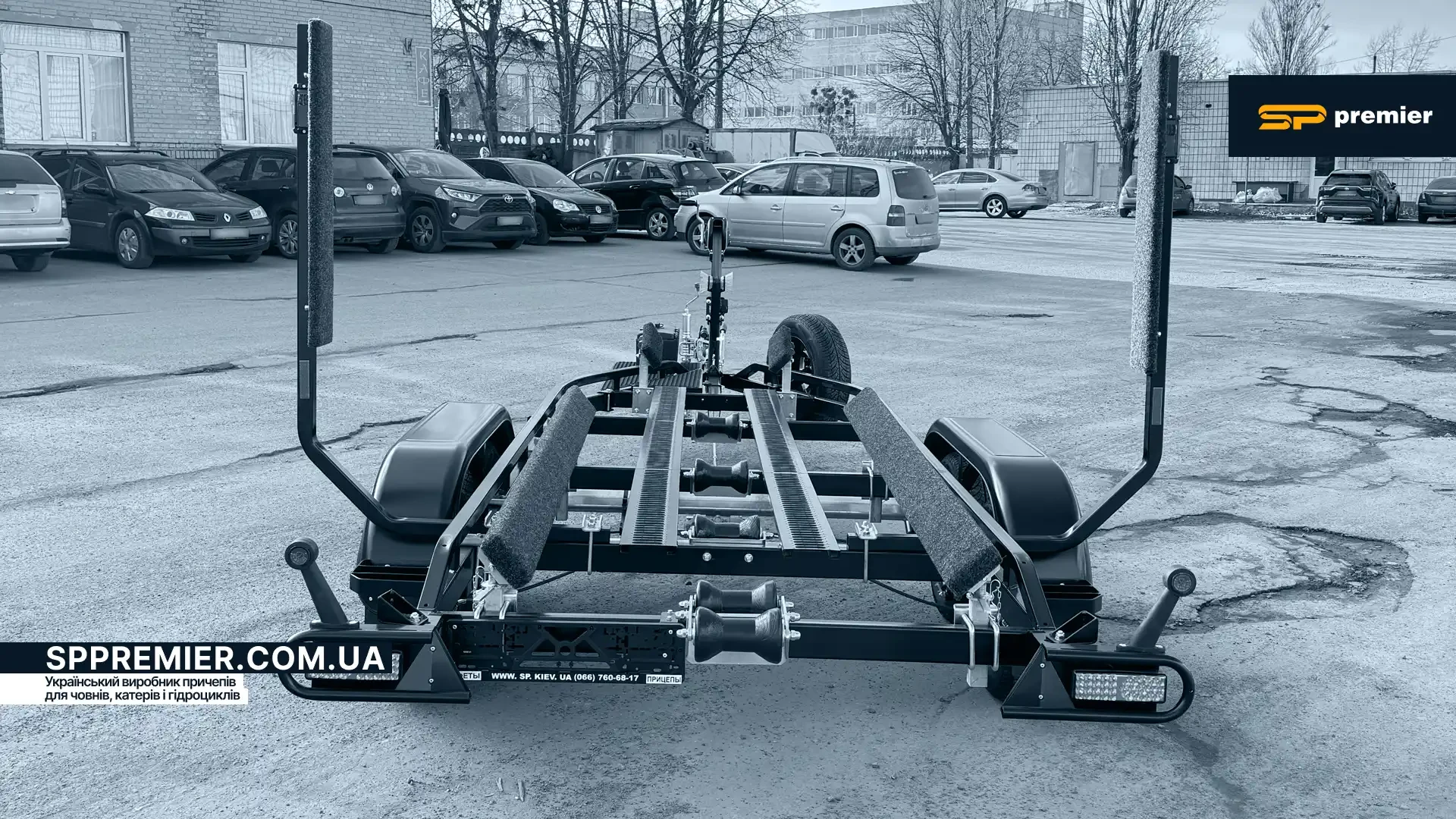
Combination trailers
Combination trailers combine rollers and bunks, making them versatile. Rollers facilitate lowering and lifting, while bunks provide reliable support during transport. These trailers are suitable for various types of boats, including motorboats and keelboats. Their advantage is flexibility in use, but their more complex design can increase the cost.
Platform trailers
Platform trailers have a flat design without specialized supports, and the boat is secured with slings or other fasteners. They are suitable for non-standard boats, such as pontoon or inflatable boats. The advantage is versatility, as the platform can carry different types of cargo. However, such trailers are less convenient for launching a boat.
Specialized trailers
Specialized trailers are designed for specific models or types of boats, such as sailing yachts with high keels or boats with unique shapes. They may have additional supports, lifting mechanisms, or adjustable elements. These trailers are ideally suited to the needs of a specific boat, but they are not versatile and are usually more expensive.
Trailers are designed for:
- Motorboats
- Jet skis
- RIB boats
- Kayaks and canoes
- Pontoon boats
- Sailboats
- Universal
Trailer running gear
The trailer suspension system directly affects the comfort and safety of transportation. It determines how smoothly the trailer will handle road irregularities, how the load will be distributed on the frame, and how long the structural elements will last.
Types of suspensions
- Leaf spring — is the most common and simple option. It can withstand significant loads and is well suited for transporting motorboats and large boats. Leaf springs are easy to repair or replace, and the system itself has a high margin of safety. The disadvantage is that at high speeds or on poor roads, shocks and vibrations will be felt, which can negatively affect both the boat and the comfort of transportation.
- Torsion suspension — is a more modern solution that uses an elastic metal torsion bar in a rubber shell. It provides a soft and smooth ride, better stability on the road, and reduces the load on the boat. The disadvantages include a higher price and more complicated repairs — usually the entire unit has to be replaced. For those who often travel long distances and value comfort, torsion suspension is the best choice.
- Without suspension — these trailers are the cheapest, but also the least comfortable for transport. They are used for light boats and jet skis. Suitable for short distances, slow transport, and flat roads. In such trailers, the wheels are attached directly to the frame, which makes them rigid — all shocks and vibrations are transmitted directly to the boat's hull, so they are rarely used for motorboats and heavy boats.
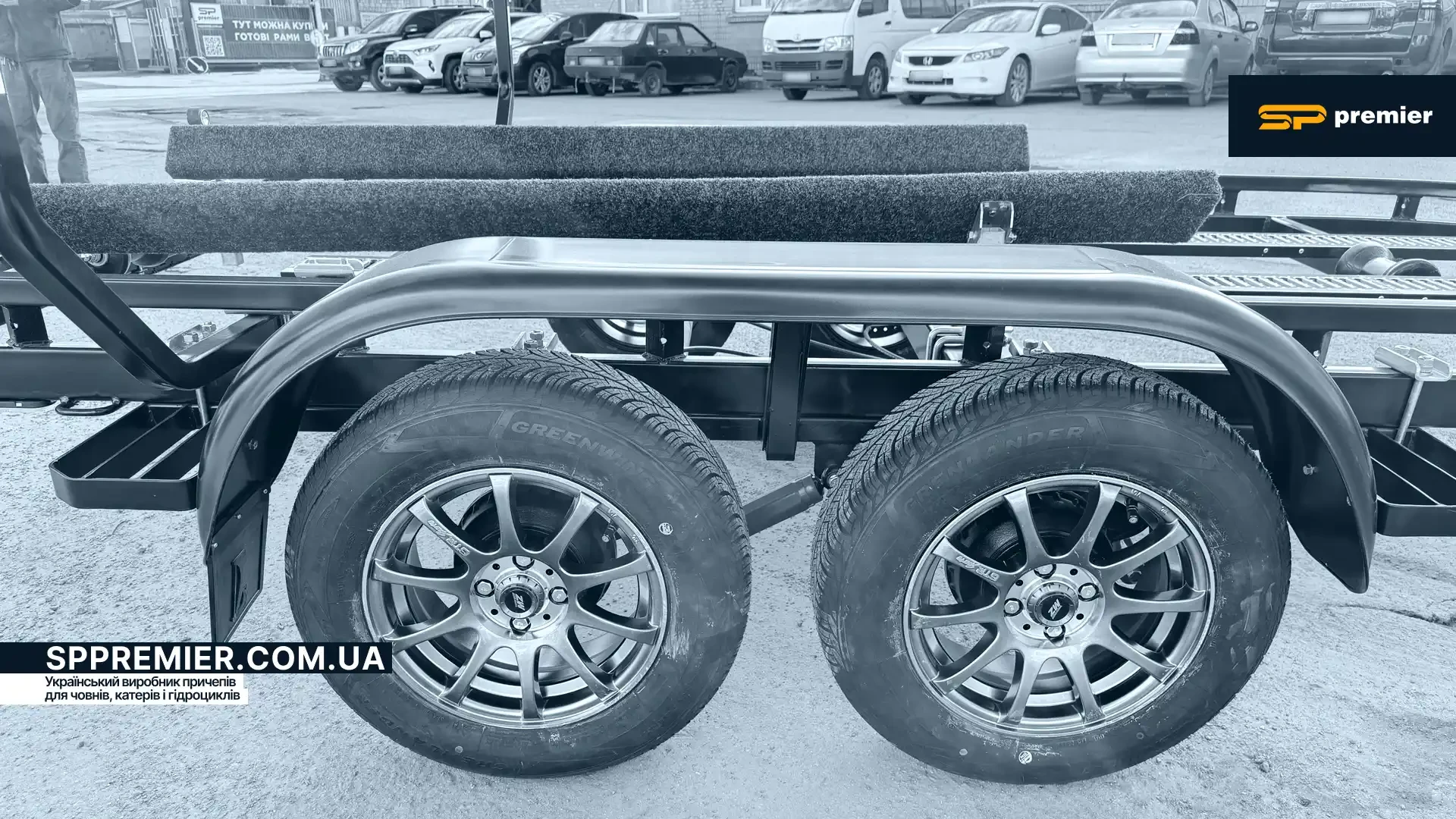
Number of axles and load capacity
When choosing a trailer for a personal watercraft or boat, the number of axles plays an important role. This parameter determines not only the load capacity and stability of the structure, but also the comfort during transportation on different roads.
- Single-axle trailers: These trailers are suitable for light watercraft such as personal watercraft or small boats weighing up to 1.5 tons and up to 5-6 m long. They are light and maneuverable, but less stable at high speeds or on uneven roads.
- Two-axle trailers: Recommended for boats and motorboats weighing between 1.5 and 3.5 tons and up to 7-8 m long. They provide greater stability and weight distribution, which is especially important on long routes or when transporting heavy watercraft. Two-axle trailers also handle road bumps better.
- Three-axle trailers: Used for large boats weighing over 3.5 tons and 8 m or more in length. Three axles provide exceptional road stability, even load distribution, and high load capacity, making them ideal for transporting oversized watercraft, such as large motorboats. However, such trailers require a powerful vehicle with sufficient towing capacity, and their size makes them difficult to maneuver on narrow roads or in urban environments.
Wheels
When it comes to wheels, it is better to choose standard car sizes — this will simplify the search for replacement tires in case of damage. An additional advantage is having a spare wheel, which will definitely come in handy during long trips.
The choice of tires depends on the operating conditions and the type of roads you plan to travel on. For mainly highway use, standard car tires with the appropriate load index are suitable. For off-road driving, you may need special tires with a more aggressive tread pattern.
The tire pressure of the trailer must be maintained in accordance with the manufacturer's recommendations and load. Insufficient pressure leads to increased tire wear and poor handling, while excessive pressure can cause a stiff ride and reduce the contact area with the road.
Braking system and safety
Trailers with a load capacity of more than 750 kilograms must be equipped with a braking system. This is a legal requirement aimed at ensuring road safety.
- The inertia braking system is the most common and operates automatically when the car brakes due to the inertia of the trailer. Such a system does not require additional connections to the vehicle's electrical system, except for signals and lighting, which simplifies operation.
- Electric brakes provide more precise braking and can be controlled directly from the driver's cab. However, they require a special controller and more complex connections.
Additional features and equipment
Modern trailers can have a number of useful features that facilitate transportation and operation. Options are usually offered at an additional cost, but they increase comfort and safety.
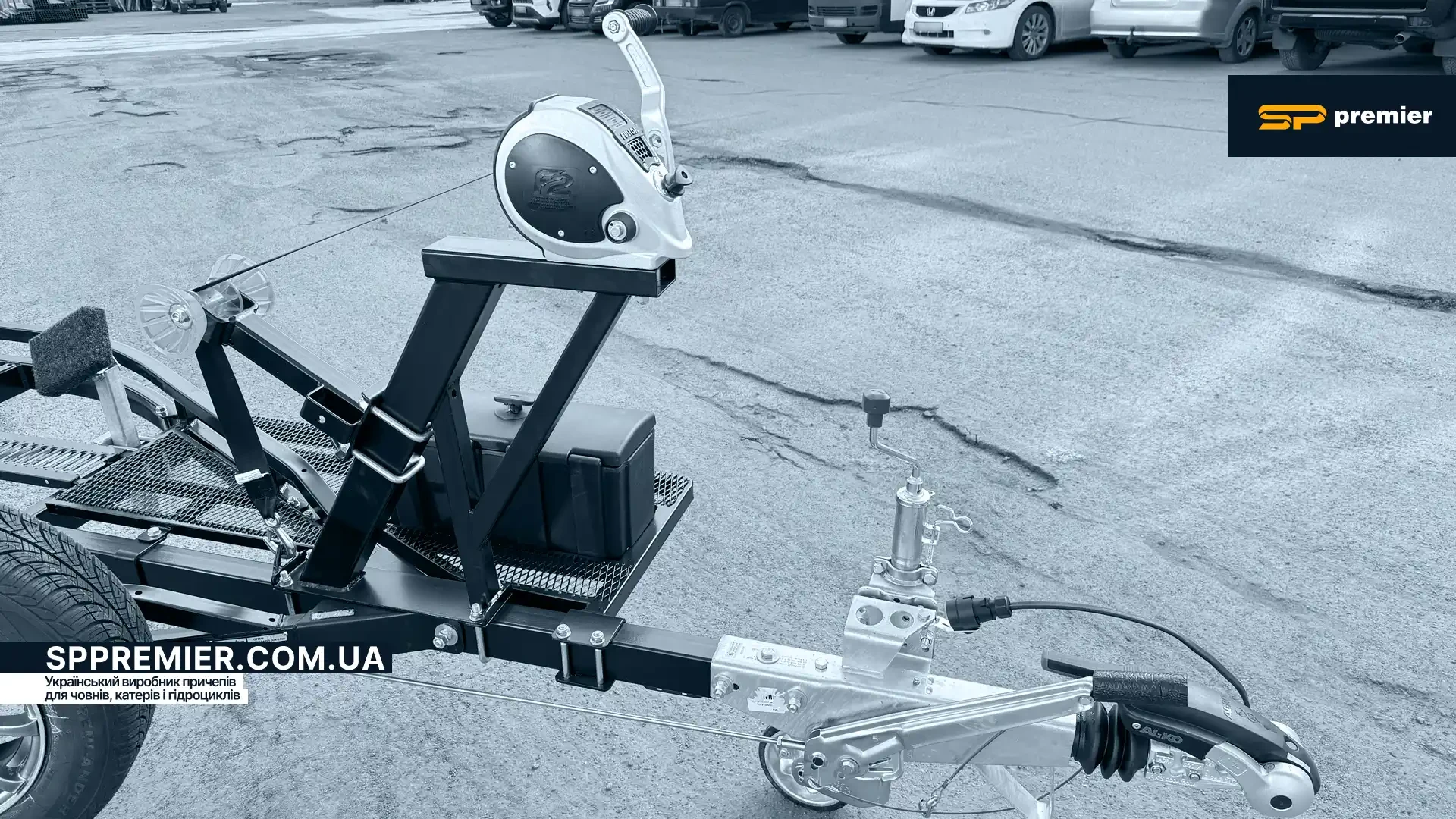
- Winch greatly simplifies the process of loading and unloading a boat, especially for heavy boats. Manual winches are suitable for small boats, while electric winches are necessary for heavier vessels. The power of the winch should exceed the weight of the boat by at least one and a half times.
- Guide system helps to load the boat onto the trailer and prevents it from shifting sideways. Telescopic guides can be adjusted in width for different boats.
- Support wheel makes it easier to maneuver the trailer when unhitched and reduces the load on the hitch when parked. It must have sufficient load capacity and a reliable lifting mechanism.
- Waterproof lights – any trailer must have lighting equipment that complies with traffic regulations: brake lights, clearance lights, turn signals. It is important that the electrical system is protected from moisture. Some manufacturers offer removable light units.
- Fastening system: straps, ties, and fasteners must securely hold the boat in place while in motion. Check whether they are included in the kit or need to be purchased separately.
- Side steps near the wheels help when attaching the boat to the trailer and also facilitate access to the hull during loading or maintenance.
Practical tips before buying a boat trailer
- Determine the dimensions and weight of your jet ski or boat together with the motor in advance. Also take into account the weight of fuel and equipment. Make sure that the trailer's load capacity matches this weight.
- Choose the length of the trailer so that the boat does not protrude beyond its limits.
- Check the rollers and bunks to see if they fit the hull and dimensions of your boat.
- Decide on the type of suspension and number of axles — this affects the smoothness of transport and the load capacity of the trailer.
- Find out if there is a braking system, which is mandatory if the boat is heavy.
- Choose the additional options you need: support wheels, lighting, side steps, fasteners, etc.
- Check the technical characteristics of your car to find out the maximum weight it can tow.
- Make sure you have the appropriate category of driver's license to drive a car with a trailer of the required weight.
- Inspect the trailer, check the quality of the welds, the integrity of the paintwork (or galvanizing), the reliability of the fastenings, and the operation of all mechanisms.
- Take a test drive, if possible, check the trailer in action — how it behaves on the road, how easy it is to load the boat.
SP Premier trailers
- Trailer Ser Buster Mini single-axle SB0901-750 — for jet skis weighing up to 750 kg. With adjustable winch and roller system. It has waterproof LED lights and headlights.
- Trailer Ser Buster single-axle spring SB0902-750 — for boats up to 5 m long and weighing up to 750 kg. With adjustable winch, roller system and spring suspension. It has waterproof LED lights and headlights.
- Trailer Ser Buster single-axle with brake system SB0903-1500 — for boats up to 5 m long and weighing up to 1500 kg. With an adjustable winch, roller and brake system. It has waterproof LED lights and headlights.
- Trailer Ser Buster two-axle SB0903-2500 — for boats up to 6 m long and weighing up to 2500 kg. With an adjustable winch, roller and brake system. It has waterproof LED lights and headlights.
- Trailer Ser Buster two-axle SB0904-2500 — for boats up to 6.5 m long and weighing up to 2500 kg. With an adjustable winch, roller and brake system. It has waterproof LED lights and headlights.
- Trailer Ser Buster three-axle SB0905-3500 — for boats and yachts up to 8 m long and weighing up to 3500 kg. With an adjustable winch, roller and brake system. It has waterproof LED lights and headlights.
Choosing a trailer for a motorboat, boat, or personal watercraft is a balance between weight, dimensions, operating conditions, and budget. A properly selected trailer will ensure safe transportation, ease of use, and durability, allowing you to enjoy your time on the water without unnecessary worries.
Ask for all the details about SP Premier trailers for boats, motorboats, and personal watercraft
Телефон: +38 097 015-15-59
Viber: +38 097 015-15-59
WhatsApp: +38 097 015-15-59
Telegram: +38 097 015-15-59
Електронна пошта: info@sppremier.com
View models of trailers for boats and jet skis in the Catalog