- What a pile foundation is
- What a ground screw pile foundation consists of
- Screw, bored or driven: how foundation piles differ
- Which structures it suits
- Which soils it works in
- Advantages and limitations
- How a pile foundation is installed: stages
- What the cost depends on
- Questions from customers
A pile foundation is a foundation in which the load of a building is transferred not to the surface layer of soil but through separate supports — piles — to denser layers below. The most common option for private construction is a foundation on ground screw piles: steel pipes with a helical blade are screwed into the ground and tied together on top by a frame that carries the structure. SP Premier has been manufacturing galvanized ground screw piles in Ukraine since 2016, so below we share a manufacturer's practical view.

A ground screw pile with a flange after installation: the foundation frame is fixed to the flange
What a pile foundation is
A conventional strip foundation is a continuous concrete strip laid in a trench along the perimeter of the building. A pile foundation works differently: the building stands on separate supports placed at a calculated spacing, and each support transfers its own share of the load into the ground.
Hence the main difference. A strip needs excavation, formwork, concrete and time for the concrete to gain strength. A pile foundation needs only points for the supports. The soil between the piles stays undisturbed, and ground screw piles can be loaded immediately after installation, with no waiting as with a concrete foundation.
A pile foundation is not a "lightweight" foundation. It is a different way of transferring the load: not over the whole area under a strip, but into points calculated for the specific structure.
What a ground screw pile foundation consists of
Piles. Each ground screw pile is a steel pipe with a helix at the bottom and a head at the top. It is the helix, resting on compacted soil, that carries the load, so it must end up below the layer that freezes in winter. SP Premier piles are made of ST3 steel with hot-dip galvanizing: zinc thickness 70 ± 10 µm, 20-year warranty, estimated service life 50–120 years.
Pile head. The SP Premier standard range has three head options: SPGS N — without a flange, for a separate pile cap; SPGS F — with a hexagonal flange, convenient for a steel frame; SPGS U — with a U-shaped flange for a timber beam or joist.
Frame (grillage). The piles are tied together into one rigid system. For a terrace or gazebo this is usually a timber beam, for a frame building a steel channel or profile, for heavier structures a reinforced concrete beam on top of the piles. It is the stiffness of the frame that determines how often the piles are placed: the spacing never exceeds 3 m.
Screw, bored or driven: how foundation piles differ
A pile foundation can be built on different types of piles. For private construction three are usually compared:
| Pile type | Installation | Loading |
|---|---|---|
|
Screw |
Screwed in by hand, with a driver or machinery |
Immediately after installation |
|
Bored |
A hole is drilled, reinforcement is placed and concrete is poured |
After the concrete gains strength |
|
Driven |
Ready-made piles are driven in by impact |
After driving, but heavy machinery is needed |
For terraces, fences, canopies, frame and modular buildings, screw piles usually win on time and amount of work: there are no wet processes, no heavy machinery is needed, and installation is possible on sites a concrete mixer cannot reach. More about the difference between concrete and pile-screw foundations in the article "Comparison of footing laying processes".
Which structures it suits
- terraces, gazebos, canopies, saunas and garden houses;
- fences, fence posts and foundations for sliding gates;
- frame and modular houses;
- sites with difficult terrain: slopes, banks of water bodies, places with level differences where a strip would require a lot of excavation.
For a residential house the calculation is made individually: we take the geometry of the structure, the number of storeys, the wall material and the frame type from the customer and select the length, diameter and spacing of the piles for the specific building.
Which soils it works in
SP Premier piles may be used on sites with the following soils:
- loams;
- water-saturated clays;
- sandy loams;
- silty and fine sands;
- sites with a very high groundwater level.
They are not recommended on stony soils and soils containing construction debris: the helix will either not pass or will be deformed, and the design compaction will no longer be achieved.
Advantages and limitations
Advantages of a pile foundation on ground screw piles:
- no excavation or concreting, so the site stays clean;
- the foundation can be loaded immediately after installation;
- installation is possible in any season, as frozen ground affects only the technique, not the calculation;
- work is possible without heavy machinery: by hand or with the SP GS 1800 electric driver;
- height is easy to level on a sloping site.
Limitations worth knowing in advance:
- stony soils and soils with construction debris are not for screw piles;
- the foundation only works together with the frame: without it, the piles are just separate posts;
- a mistake in length is costly: if the helix stays in the frost layer, the support will be pushed out;
- screw piles must never be driven: an impact deforms the helix, and the design bearing capacity no longer applies.
How a pile foundation is installed: stages
- Calculation. The length, diameter, spacing and number of piles are determined. Length is calculated with the formula L1 = A + L2 + H, where A is the standard frost depth, L2 the helix length and H the flange height above ground. The step-by-step calculation is in the article "Calculating a ground screw pile foundation".
- Marking out. The perimeter and all pile points are marked on site: corners, wall intersections, point loads and spans at the chosen spacing.
- Screwing in. The piles are screwed to the design depth. The deviation from vertical must not exceed two degrees and is checked throughout the screwing.
- Levelling. The pile heads are brought to one level for the frame.
- Frame. The piles are tied with a beam, a steel profile or a grillage, after which the foundation is ready for further work.
Piles can be screwed in three ways: by hand for small diameters and shallow depths; with a hand-held electric driver where machinery cannot reach; with hydraulic rigs mounted on BOBCAT and AVANT loaders where there is access. In Kyiv and the Kyiv region SP Premier offers turnkey ground screw pile foundation installation.
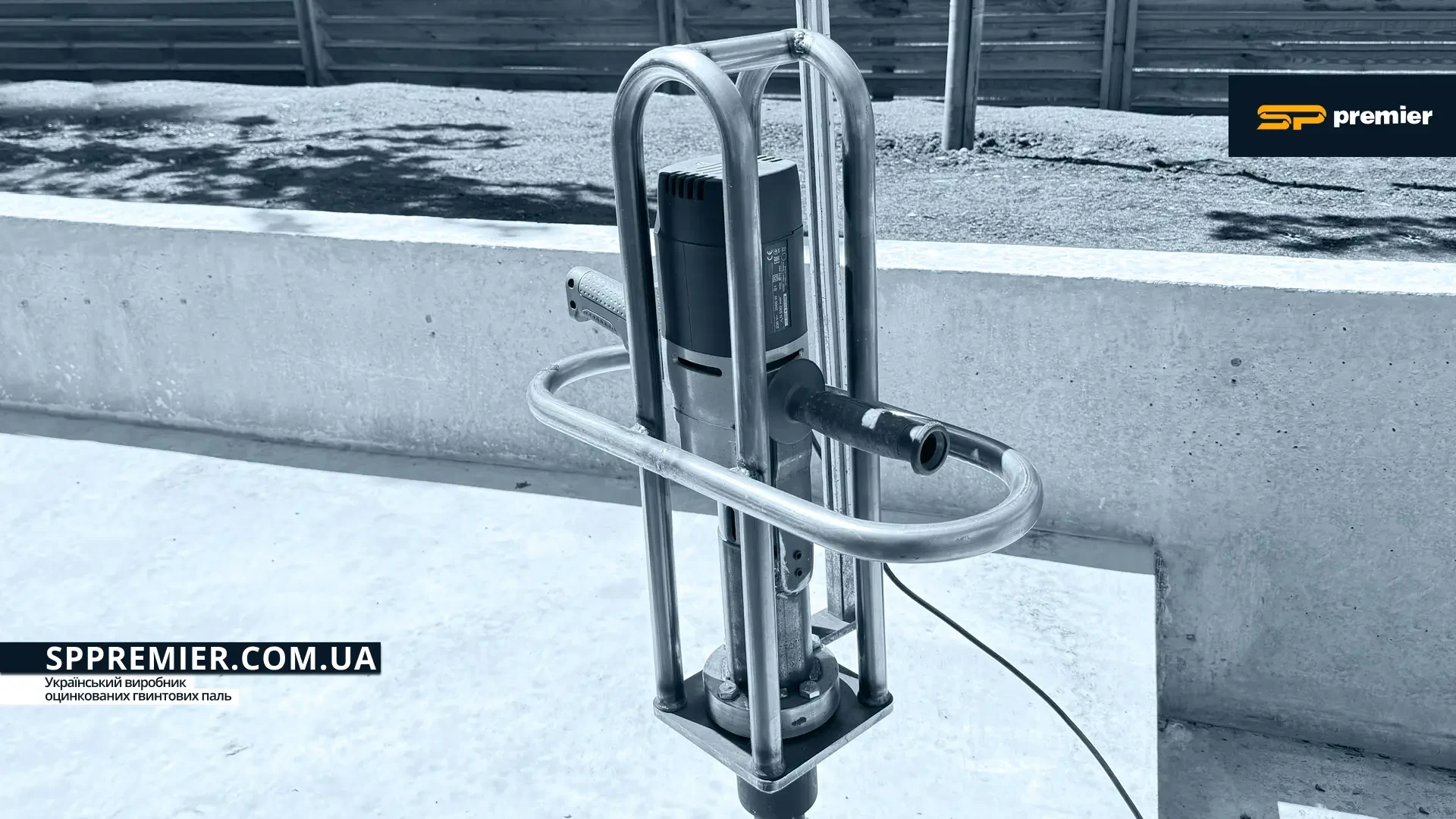
SP Premier hand-held electric driver: installing a pile foundation without special machinery
What the cost depends on
The estimate for a pile foundation has two parts (piles and installation) and depends on several factors:
- number of piles is set by the layout along the perimeter, the spacing and point loads;
- diameter and length depend on the load per support and the frost depth in your region;
- installation method: by hand, with an electric driver or with machinery;
- site conditions: access for machinery, terrain, soil.
For an accurate calculation, send us the dimensions of the structure, the wall material and the frame type, and we will select the piles and calculate their number.
Questions from customers
How long does a ground screw pile foundation last?
The estimated service life of galvanized SP Premier piles is 50–120 years depending on the soil; the manufacturer's warranty is 20 years.
Which is better: a pile or a strip foundation?
It depends on the structure and the site. For terraces, gazebos, fences, frame houses and sites with difficult terrain, a pile foundation on ground screw piles is usually faster and needs no concrete work. For heavy masonry buildings and stony soils other solutions are more often chosen.
Can a pile foundation be built in winter?
Yes. The frost depth in the calculation is a standard value that already accounts for the winter season, and frost affects only the installation technique. More in the article "Can screw piles be installed in winter?".
Can I build a pile foundation myself?
For a light garden structure, yes: small-diameter piles can be screwed in by hand or with a hand-held electric driver. The key is to calculate the length correctly and keep the piles vertical and at the right spacing.
Contact us to calculate your pile foundation and order SP Premier ground screw piles!
Phone: +38 050 431-70-60
Viber: +38 050 431-70-60
WhatsApp: +38 050 431-70-60
Telegram: +38 050 431-70-60
E-mail: info@sppremier.com

